Last updated 09/05/2026.

In 2026, the smarter trip is not always the most famous city or the cheapest ticket. It is the place, season, hour, and experience that still lets the day feel generous. Treat crowding like a real cost before you book.
The next big travel divide is not budget versus luxury. It is friction versus memory.
Two people can book the same city and have completely different trips. One gets the version that feels alive: the right hour, a clear route, a guide who adds context, a meal that is not rushed, a neighborhood that still has air in it. The other pays the crowd tax: fees, heat, queues, full sidewalks, thin patience, and a day that becomes more about managing pressure than enjoying the place.
That crowd tax is now visible. Venice's official visitor guidance says day visitors to the historic center will need to pay EUR 5 or EUR 10 on selected days between April 3 and July 26, 2026, unless exempt. Booking.com's 2026 research says travelers are already adapting by avoiding crowds, shifting outside peak season, and looking for cooler destinations. Expedia's Unpack '26 report frames its destination list around places rising "Beyond the Crowds" and a tourism health check. TUI Musement says demand is rising for second cities and local experiences.
The crowd tax is not just money.
A fee is easy to notice. The hidden costs are worse. A packed old town changes how slowly you can walk. A midday heat wave changes whether a square feels romantic or punishing. A sellout calendar changes whether you get the experience you wanted or the leftover time slot. Resident frustration changes the mood of the place, even when nobody says anything directly to you.
That is why the 2026 travel rule is simple: do not ask, "Where is everyone going?" Ask, "Where can this trip still give me the day I want?"
The rule
Choose the version of the trip with the lowest friction-to-memory ratio.
If the answer is you, build the day differently. That cost can be a fee, a timed-entry scramble, a hotter month, a packed lane, a long transfer, or a rushed local community.
Keep the famous anchor if it truly matters, then shift the date, hour, neighborhood, base city, or nearby experience so the trip stops fighting the same crowd as everyone else.
A better food walk, ferry route, museum hour, local guide, or day trip can beat the headline attraction when it gives you more access and less friction.
If heat, crowding, weather, or local rules change the plan, the second choice should still feel like a real trip, not a consolation errand.
Keep the icon only when it earns the day.
This is not an argument against famous places. Paris, Rome, Venice, Barcelona, Tokyo, and New York are famous because they deliver. The mistake is letting the famous thing become the whole plan when the conditions around it make the day worse.
If the anchor is truly worth it, protect it. Book the better time. Choose the clearer meeting point. Pay attention to access level. Add a buffer. Use the rest of the day to get away from the crush instead of stacking more crowded stops.
For example, Eiffel Tower tickets can make sense when the timing supports the evening. Colosseum tours can make sense when the guide, access level, and heat window are right. Venice can still be extraordinary when you give yourself quieter routes, lagoon time, and fewer checklist obligations.
Second cities are not second-best anymore.
The interesting shift is that travelers are not only escaping crowds. They are getting better at naming what they actually want: food, local life, sport, design, nature, a festival, a slow neighborhood, or one tour that makes the destination click.
That is why second cities and nearby towns are becoming more useful. They often give travelers the same emotional category with less drag: historic streets without the constant squeeze, strong restaurants without impossible reservations, cultural depth without spending half the day in lines, and day trips that do not feel like a tactical operation.
The practical move is not "skip the famous place." It is "build the trip around the experience, then choose the place that treats that experience best."
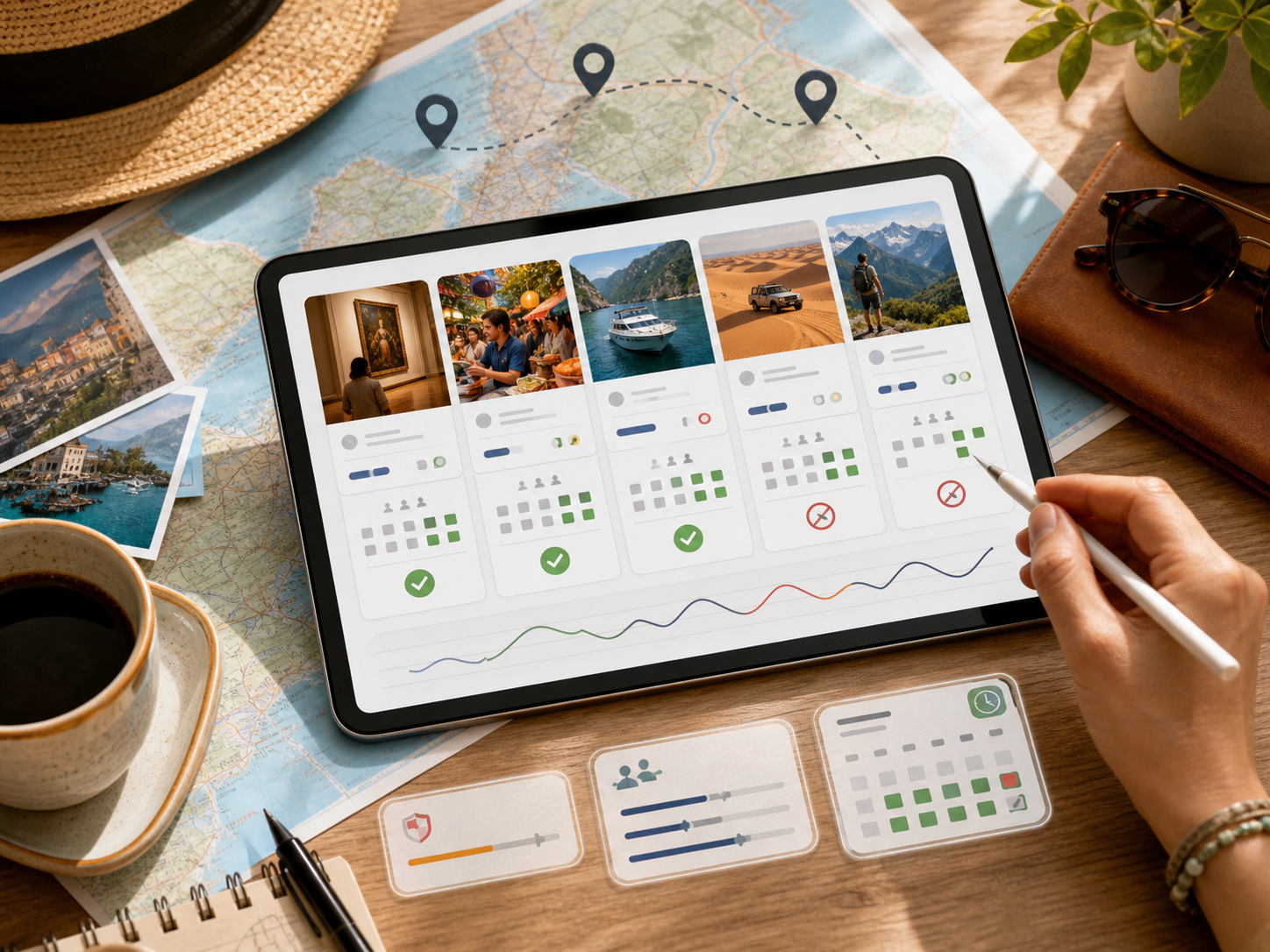
The group-chat version.
Send this before the trip turns into a popularity contest:
What do we want the day to feel like, and which destination gives us that feeling with the least crowd tax?
That one question changes the conversation. The group stops debating famous names and starts comparing outcomes: better food, easier timing, less heat, fewer queues, clearer access, more local value, and one memory that survives the logistics.
How to book around the crowd tax.
Start with one anchor experience. Then test the trip against four pressure points: season, hour, neighborhood, and backup. If all four look strained, change something before you pay.
Move the date by a few weeks. Pick the first or last time slot. Sleep in the smaller base city and day-trip into the icon. Replace a crowded landmark with a guided route that gives you context and room. Trade the obvious overlook for a food walk, boat route, museum hour, desert sunset, local market, or neighborhood experience that still feels like the reason you traveled.
This is where TopTravel.ai is useful. Our destination and tour pages are built for the pre-booking moment: what the experience is, who it fits, what to compare, what can go wrong, and when to check live availability with the provider.
Browse TopTravel.ai guides, pick the anchor that makes the trip worth it, then verify live prices, reviews, availability, meeting points, and cancellation terms before booking.