Last updated 09/05/2026.
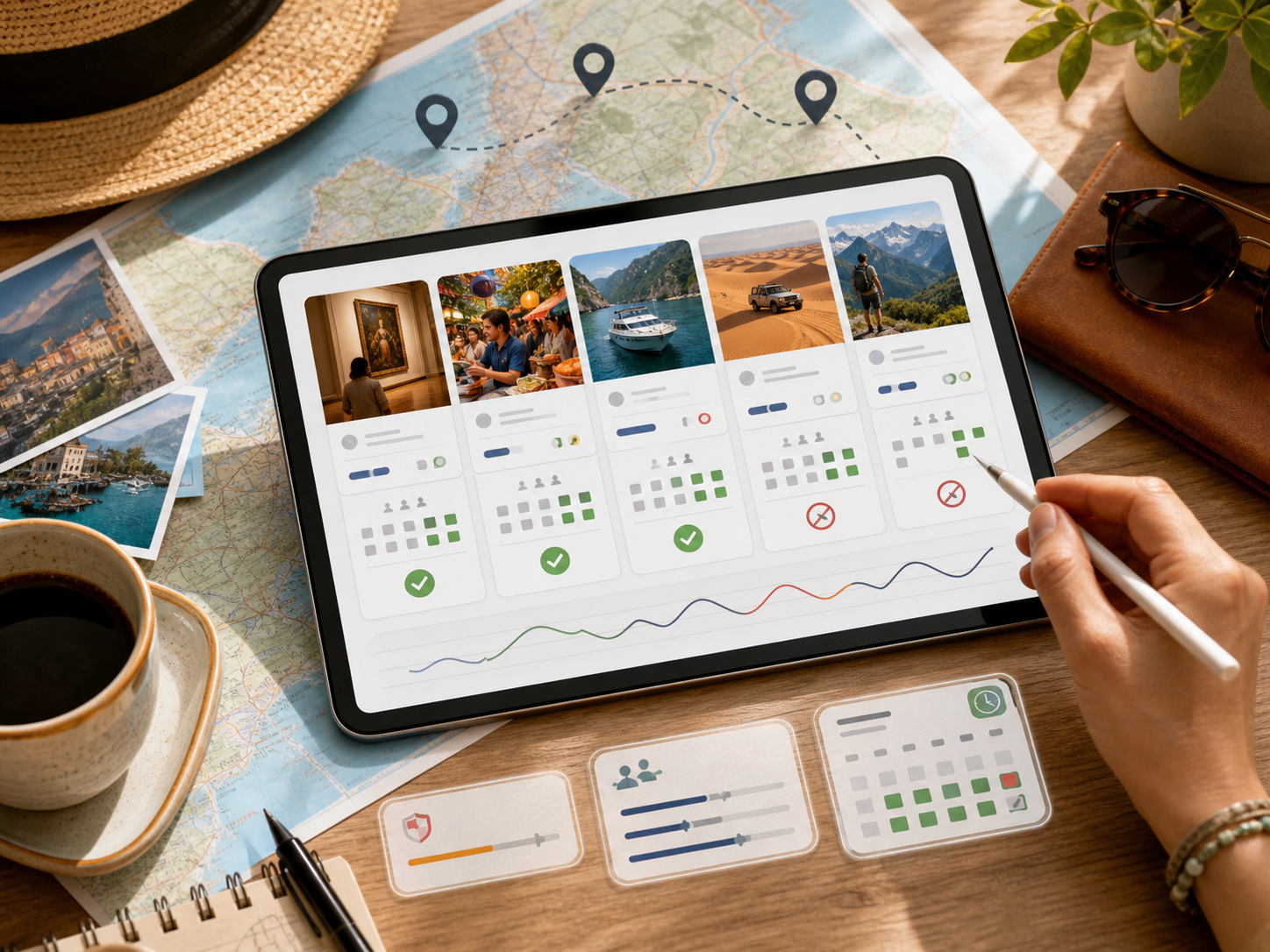
Do not plan day one from the city. Plan it from the airport. If the first transfer, luggage, check-in, food, and energy level are not handled, the best-looking itinerary becomes a stress test.
The most expensive travel mistake is not always a bad hotel or an overpriced tour. Sometimes it is booking something exciting too close to landing, then watching the whole day get eaten by immigration, baggage, traffic, check-in rules, hunger, and the quiet math of jet lag.
The airport-first rule fixes that with one move: before booking any arrival-day experience, prove that the first transfer works. Not theoretically. Actually. With luggage, tired people, local traffic, hotel timing, and a realistic meal plan.
Day one has three clocks.
The first clock is the airline clock. It tells you when the plane is scheduled to land. Useful, but incomplete.
The second clock is the city clock. It includes immigration, baggage, rideshare waits, train transfers, traffic, neighborhood distance, and hotel check-in. This is the clock most travelers ignore.
The third clock is the body clock. It decides whether your group can handle a museum, food walk, boat ride, show, or late dinner without turning the first memory into survival mode.
Arrival-day test
Answer these before booking anything timed.
Treat the listed arrival as the start of airport processing, not the start of your vacation. Add immigration, baggage, transit, and check-in reality before booking anything timed.
Know when you can actually enter the room, drop bags, shower, or reset. A beautiful plan falls apart fast when everyone is tired and carrying luggage.
Map the airport-to-hotel route before you compare tours. If that transfer is messy, every timed plan after it inherits the risk.
Assume arrival-day energy is lower than your planning brain thinks. Save the big-ticket memory for the first full day unless the timing is effortless.
Keep one low-friction option nearby: a short walk, easy dinner, neighborhood viewpoint, or flexible evening activity you can skip without regret.
The rule is simple.
On arrival day, book only experiences that can survive a two-hour delay, a low-energy group, and a bag problem. If the plan collapses when one of those happens, move it to the first full day.
This does not mean wasting the first day. It means choosing a first day that works in real life: settle in, eat well, walk the neighborhood, get the city into your body, and keep one flexible option nearby.
Where people get trapped.
They see a landing time at 10:20 a.m. and imagine lunch by noon, hotel by one, landmark by three, sunset tour by six. That plan is technically possible in some cities. It is also fragile in almost every city.
Fragile plans are the enemy of good trips. They force every small delay to become a decision. Do we still go? Do we skip food? Do we eat the cancellation? Do we drag luggage across town? Do we make everyone pretend they are fine?
Group-chat version
Send this before day one gets overbuilt.
Nothing timed until bags, room access, food, and transfer are solved. After that, choose one easy win near where we are already sleeping.
What to book instead.
Arrival day is good for flexible neighborhood walks, easy viewpoints, casual markets, short evening cruises with forgiving timing, simple dinners, or a low-pressure activity near the hotel. It is usually bad for strict timed entry, long cross-city transfers, major museums, big day trips, or anything your group would be sad to miss.
Save the once-per-trip moment for the first full day. That is when a Paris viewpoint, Colosseum route, Tokyo food walk, or Dubai desert safari has a much better chance of becoming the memory you wanted.
The hidden win.
When day one is calmer, day two gets better. You wake up oriented, fed, rested, and less resentful of the trip you planned. That is the part people underestimate. A protected arrival day does not reduce the trip. It increases the odds that the rest of it lands.
Use TopTravel.ai pages to compare the experiences worth protecting, then verify live timing, meeting points, cancellation rules, and provider notes before booking.
Use arrival day to get stable. Then compare tours, tickets, food walks, and day trips with a clear head.